
Pool Calculator
Find how many gallons your pool holds, then a measured starting dose for each chemical you add.
1 of 3
Your gallons appear here after step 3.
Already know your gallons? Go straight to your dose
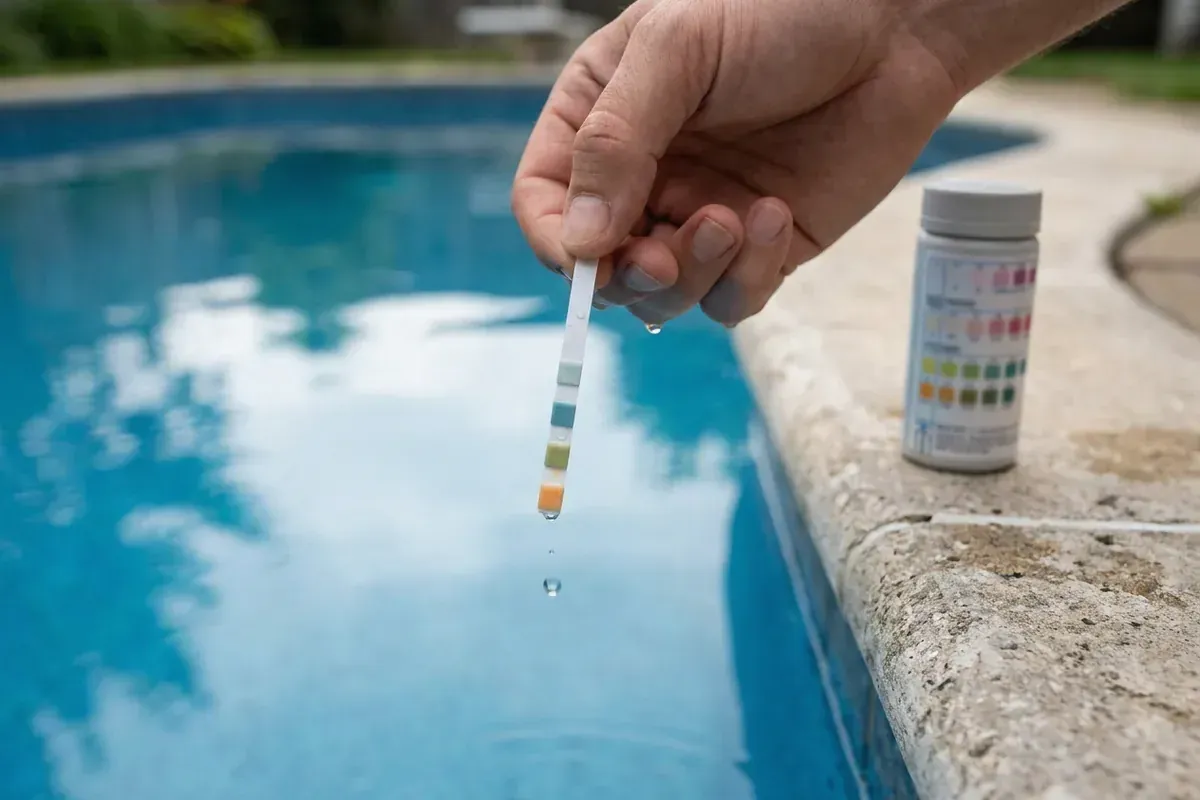
A pool calculator tells you the volume of your pool in US gallons, and that figure drives every chemical dose. All doses here are based on US gallons.
- Pool size: a 16 x 32 ft pool averaging 4.5 ft deep runs about 17,200 gallons
- Chlorine: in 10,000 gallons, 10 fl oz of liquid chlorine lifts free chlorine by 1 ppm
- pH: aim for 7.4 to 7.6
- Alkalinity: keep it between 80 and 120 ppm
Doses for 10,000 gallons of water
Every amount below assumes 10,000 gallons. Got 20,000? Double it. Got 5,000? Cut it in half.
| Product | What it changes in 10,000 gallons | Amount | Metric |
|---|---|---|---|
| Liquid chlorine 12.5% | Free chlorine up 1 ppm | 10 fl oz | 305 mL |
| Liquid chlorine 10% | Free chlorine up 1 ppm | 13 fl oz | 380 mL |
| Cal-hypo 65% | Free chlorine up 1 ppm | 2.1 oz | 60 g |
| Dichlor 56% (adds 0.9 ppm stabilizer) | Free chlorine up 1 ppm | 2.4 oz | 70 g |
| Trichlor 90% in a floater (adds 0.6 ppm stabilizer) | Chlorine fed by tablets, per 1 ppm | 1.5 oz | 40 g |
| Liquid chlorine 12.5% | Shock, free chlorine up 10 ppm | 102 fl oz | 3.03 L |
| Muriatic acid 31.45% | pH 7.8 down to 7.5 | 9 fl oz | 270 mL |
| Dry acid 93.2% | pH 7.8 down to 7.5 | 12 oz | 350 g |
| Soda ash | pH 7.2 up to 7.5 | 1 lb 1 oz | 495 g |
| Baking soda | Alkalinity up 10 ppm | 1 lb 6 oz | 635 g |
| Muriatic acid 31.45% | Alkalinity down 10 ppm | 26 fl oz | 755 mL |
| Cyanuric acid | Stabilizer up 10 ppm | 13 oz | 380 g |
| Calcium chloride 77% | Calcium hardness up 10 ppm | 1 lb 3 oz | 545 g |
Add half, let the pump mix it, test again, then add the rest: 30 minutes for chlorine, acid and soda ash, a day for baking soda and calcium, and up to a week for stabilizer. Acid always goes into water, not water into acid, and acid never meets chlorine. For your own gallons, use the pool chemical calculator or print the dosage chart.
Adding chemicals safely
There is a reason behind each step. They help the water mix evenly and keep chemicals from reacting with each other.
- 1. Turn on the pump first so the chemical reaches every part of the pool.
- 2. Put in one chemical at a time, right where a return jet pushes water out.
- 3. When diluting acid, the acid goes into the water, not the other way around, since splashing acid can burn you.
- 4. Do not let acid and chlorine touch or mix, because that combination is dangerous.
- 5. Wait 30 minutes after adding acid or soda ash, then test pH again.
At normal chlorine levels, wait roughly half an hour after liquid chlorine before you swim. After a shock, stay out of the water until a retest shows free chlorine back in the normal range for your stabilizer (3 to 5 ppm at 30 ppm) and no higher than 10 ppm.